AI & the Future of Work
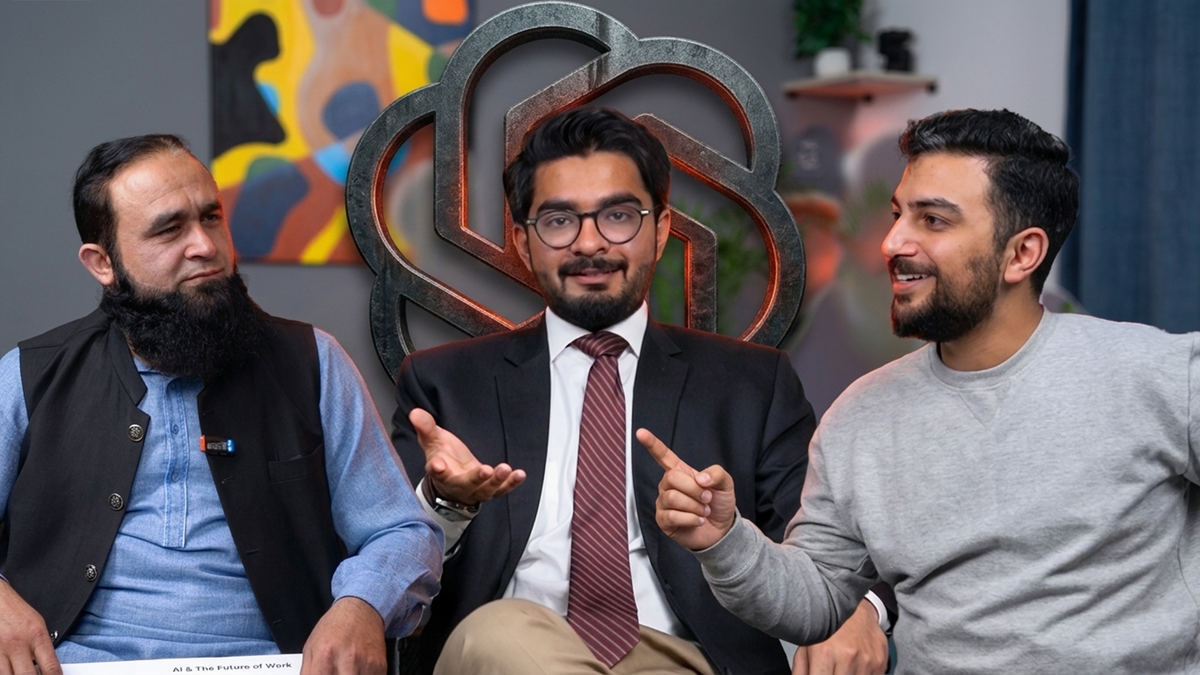
Popular student podcast show host, Fakhar Abbas, interviews Grayhat's CEO, Saad Bazaz, along with Maaz Ali Nadeem, CEO of Vector AI.

The original podcast was recorded in the Urdu (اردو) language. The transcript below is a translation, written by AI and edited by humans. There may be mistakes.
FAKHAR ABBAS: Assalamu Alaikum, dear viewers. How are you? Are you all right? I'm your host, Fakhar Abbas.
A week ago, we posted on LinkedIn, Facebook, YouTube, and Instagram about the "AI bubble" that's troubling many students. Even graduates are worried about what they'll do next. In that post, I featured two experts—Maaz Ali Nadeem and Saad Bazaz—and we invited them to address your concerns.
Students are asking: "Which degree should I pursue? AI, cybersecurity, computer science? What skills should I learn? And even if I have skills, will AI take away our jobs?" There's a lot of fear and doubt.
To clear those doubts, we arranged a special podcast for you. Our guests are industry insiders and prominent AI experts. They'll give their responses, and we'll compare them—live—with ChatGPT. How closely do their answers align with ChatGPT? Where do they differ?
We collected questions from many of you, and this podcast is based on those questions—the real concerns of students. So please watch until the end.
Now, let me introduce my guests.
Sitting with me is Maaz Ali Nadeem, co-founder and CEO of Vector AI. He is a graduate of FAST AI, 20th batch, Islamabad campus.
Also with me is Saad Bazaz, a graduate of CS 18th batch, FAST Islamabad campus. He is co-founder and CEO of Grayhat Developers.
I have great respect for both of them. Bringing such busy people from the tech industry requires a special request. The purpose of this session is to help solve your problems through their advice.
I'll now ask them to briefly introduce themselves, even though I've already said a little.
SAAD BAZAZ: Thank you so much. My name is Saad. As Fakhar said, I'm the CEO and co-founder of Grayhat. I've been working in media since I was 15—about nine to ten years now. Later, I shifted to Computer Science for my degree and did software engineering work. Then, luckily, I started working with a company in Norway, and we founded Grayhat. Some of our clients came from Silicon Valley. Since then, we've expanded. I love coding and engineering on the side, and designing things in Figma—taking them from idea to completion is my hobby.
MAAZ ALI NADEEM: Thank you. I started a little earlier—before graduating, actually before university. My first venture was selling knock-off shoes from the Russian market to Europeans while I was in Beijing. Then we created a hoodie brand called Easy back in 2019, pre-COVID, and ran it until COVID hit. After that, I came back to Pakistan and chose to pursue higher education. That was very difficult at first. During research, I realized I just couldn't do research. So eventually, building a company and being the front face of one was the right path for me.
We actively work on multiple AI-native implementations worldwide, primarily in Australia, a bit in Pakistan, Canada, and the U.S.—though not very aggressively. Right now, our focus has shifted slightly toward Europe. We've built a lot of things, and many people are using them. But that's not the point today. The point is that we'll share insights based on our failed experiences. Insha'Allah, that's the goal.
FAKHAR ABBAS: And your core work—is that AI-related?
MAAZ ALI NADEEM: 100% AI-related.
FAKHAR ABBAS: What about you, Saad? Is your work also AI-related?
SAAD BAZAZ: Basically, we form a triangle: applications, gaming, and AI. We mix and match AI applications, AI games, and so on. So yes.
MAAZ ALI NADEEM: And ours is a pyramid: foundational models, then workflows, then platforms, then sales. We're building a pyramid of AI solutions.
FAKHAR ABBAS: We selected questions you shared. There were some redundant ones, which we filtered out. There were many great questions. We have about fifteen questions, plus some follow-ups.
I'll read each question one by one. Our panel will give their response, and then we'll compare it with ChatGPT using the same prompt.
First question: Is coding going to become obsolete?
SAAD BAZAZ: First, I don't fully understand the fascination with coding, honestly. I've been coding for a long time and still do it on the side. For me, coding is a way of expression, a way to give instructions to a machine. Whether you do that through a high-level language, a design tool, or an LLM doesn't really matter. That said, I don't think software engineering is going anywhere in the next five years at least. Coding itself might evolve because these high-level languages were made for humans, but low-level coding will still thrive. People might start coding more in Rust, Go, and other low-level languages like C and C++ if they want to.
FAKHAR ABBAS: To keep it short, what would you say? If you could explain in Urdu as well.
SAAD BAZAZ: The kind of coding people are probably talking about—React coding—that might reduce a little, but not in the long run. We still need to talk to computers using programming languages. That kind of coding won't go away.
FAKHAR ABBAS: So Maaz, what is your take? Is coding going to be obsolete?
MAAZ ALI NADEEM: I think Saad summarized it well, but I'll add one thing. The term "coding" basically means translating a set of instructions into software. That translation process is becoming obsolete—or at least heavily assisted by AI tools that can even replace it, given the right instructions. Engineering, however, is not being replaced. Engineering means planning software so that it is scalable, testable, and actually works. Just works. We look at many government or public service platforms. The problem is often that banking systems are down, or something isn't working. That engineering—getting it right—is going to remain, because that problem hasn't been solved yet. Sure, you can translate "this button will work like this" and "this button will take you to that page," but that's fine.
FAKHAR ABBAS: But big tech CEOs, like Claude's CEO and Elon Musk, say coding will become useless. They say it won't even be taught as a subject. Students are very afraid. What do you say from that perspective?
SAAD BAZAZ: They are right, I think. Take an example from before LLMs. Everything was already templatized. If you wanted to make a SaaS app, a template was available. You'd pick it, apply it, make tweaks. That was all within our domain. Look at another domain: chip design. Someone showed me the chip design lifecycle, and I thought, "This sounds so familiar." It was basically the same as the software development lifecycle, just with minor tweaks. It turns out a similar thing happened in chip design. Powerful chips are now developed in modules. No one designs individual transistors or gates anymore. This has happened before in other industries. You might be seeing it in software engineering for the first time, but it's not new. There's nothing to be worried about.
MAAZ ALI NADEEM: Yes, nothing to be afraid of. It's a good thing. We'll have more time to think. Manual translation into code is being replaced, sure. But the thinking process remains. If no one had to think at all, then there would be room for fear. But that's not the case.
FAKHAR ABBAS: That was our first and very crucial question. Now, the second one: People used to learn coding by studying programming fundamentals, then OOP, data structures, and so on. Separate courses. How much will that change now? Should we learn the same way or differently?
SAAD BAZAZ: It will be a bit different. It will become more logic-based. Pseudo-code will become more important. You need to learn logic, algorithms, and how to design a proper system—whether it's electrical, software-based, or mechanical. You need good logic.
FAKHAR ABBAS: Maaz, what do you say? Compare the coding you learned when you started versus how students in university should learn now.
MAAZ ALI NADEEM: I think we should put more pressure on them than ever before. It's easier to get things done now. No matter how much you try to stop students, they'll still go home and open ChatGPT or Claude. So, pseudo-code is definitely important for logic building. You'll have to get them to write extremely complex pseudo-code. And to ensure proper engineering, you should also have them write actual code at a younger age. They should translate their pseudo-code and test it, because until you run it, you cannot test it or identify use cases. I think it should get harder, not easier. That's the challenge for faculty and academia: how to make it more difficult.
FAKHAR ABBAS: Thank you. Now let's see what ChatGPT says. Is coding going to be obsolete?
ChatGPT: <response>
FAKHAR ABBAS: Almost the same response.
MAAZ ALI NADEEM: So this confirms we have the right people sitting here.
FAKHAR ABBAS: Now the second question from the audience: Will AI take away jobs in Pakistan? This is very crucial. Layoffs are happening in other countries. How much impact will there be in Pakistan?
SAAD BAZAZ: I don't think AI will take away too many jobs in Pakistan right now, because Pakistan hasn't been fully digitized yet. When people in other countries talk about job losses, they're talking about white-collar or desk jobs. There aren't that many of those here to begin with. Pakistan still needs to adopt management systems and ERPs—they're still just a trend right now. So there's still a long way to go. There will actually be more job creation.
FAKHAR ABBAS: That includes two groups: people working in Pakistan's local organizations and corporate sector, and Pakistanis doing remote jobs abroad. They will be affected, won't they?
SAAD BAZAZ: Definitely, they will. Having a person behind a screen versus a terminal in the cloud is essentially the same thing.
FAKHAR ABBAS: What do you say, Maaz?
MAAZ ALI NADEEM: It's scary. Recently, we delivered a project at Vector that led to ten people being laid off at a company in Karachi. That's not something to be proud of. I was recently in Davos with a Global Youth Alliance that includes Accenture and the World Economic Forum, and they think about these issues. I pointed out that the team replaced by our AI transformation—we had to earn money, but the company wanted to replace them—those people were middle-aged. Thirty-five to forty years old, with families and children. They weren't earning six-figure PKR salaries, probably sixty to seventy thousand rupees a month. That was their major source of income. So that's critical.
The good thing about the first world is that when they replace someone, they think about reskilling them using CSR funds. They invest in placing those people elsewhere. That's a lot of money. Pakistan and other third-world countries cannot invest that money. If people are replaced here, that's it. They go home and have to find the next job themselves.
SAAD BAZAZ: I disagree a little with the narrative that jobs are going away. That narrative is mostly coming from the West—from Canada, the U.S., whose economies are declining. When their economy goes down, Meta lays off 1,000 or 2,000 people, AWS lays off people, and they label it "AI transition." But if you use their applications, the quality has dropped so much that it seems those people they laid off were pretty useful!
Think about it: if you have a tool that makes each person ten times more productive, why would you lay people off? Your incentive should be: if I have 1,000 people, they can now do the work of 10,000. If I have 10,000, they can do the work of 100,000. They will do more work. Layoffs are not directly caused by AI; they are a direct indication of a declining economy.
FAKHAR ABBAS: AI is not only eliminating jobs but also creating them.
MAAZ ALI NADEEM: Creating jobs for educated people.
SAAD BAZAZ: No, even for others. AI artists have emerged—people who have been empowered by these tools. I think AI will create more jobs and more upgrades. This scary narrative from the West is frightening people. Pakistan already had so few jobs to begin with. What's the worst that can happen?
MAAZ ALI NADEEM: That's true, and it's a big narrative. But somewhere along the line, it will put a lot of pressure on us, absolutely.
FAKHAR ABBAS: Let's see ChatGPT's response. Will AI take away more jobs in Pakistan?
ChatGPT: <response>
FAKHAR ABBAS: People in the automation industry talk about this. I was reading about AWS Cloud—they laid off many people, put them on automation, and later suffered huge losses and a slowdown.
SAAD BAZAZ: CloudFlare also had an outage recently, and they also had layoffs. The CTO of AWS said you can lay off people, sure, but you cannot replace juniors. Juniors are an essential part of your human workforce. That narrative is coming from the West, but what Maaz said is absolutely right: if you don't upskill people and they are doing redundant work, that is a bad thing.
FAKHAR ABBAS: We'll also talk about which skills you need to learn to stay relevant in the AI world. Next question: Is AI just a hype cycle or a long-term infrastructure shift?
MAAZ ALI NADEEM: It is a long-term infrastructure shift, yes—if applied with some thought. It is in a hype cycle right now, sure, and there's also a bubble that will burst. Every hype cycle bursts. But this isn't just a bubble that will burst and disappear. It will stay. During the blockchain era, the hype cycle went bust and couldn't transform anything afterward. Everyone thought everything in Pakistan would be tokenized—real estate, rooms, everything. That didn't last. With AI, it will be more natural. It is already happening and proving results. This is definitely a long-term thing. It will be implemented in your banks as well. Whether it's implemented in Pakistan first or not isn't the question—it's being implemented in the world. AI is already handling many after-hours tasks. Somewhere, it's enabling a business to stay relevant 24/7, answering calls, triggering workflows, providing good ROI, increasing revenue. No one hates more money coming in. So it's here to stay. There will be a bubble burst, then people will identify specific use cases to mature. Once it matures, it will definitely work. It's like when pens came—they never went away. Same with electricity. This is that kind of thing.
SAAD BAZAZ: I 100% agree with Maaz. This was inevitable. People have been prophesying this since the 1950s and 60s—that one day robots would be made. It's human nature to evolve. The question is whether this particular wave will run. Architecturally, the main backbone is the transformer architecture, which hasn't been updated since 2017. Eight years with the same architecture—variations have come, but foundationally it's still the transformer. If you're building a data center the size of an entire city, like Mark Zuckerberg is doing for $50 billion, that feels a bit rushed. You're not doing as much foundational research as you are betting on it. You're subsidizing it heavily. Honestly, paying $20 for ChatGPT is basically harming them financially. They are pushing too fast and not researching AI sustainability. Data centers are not sustainable that way. I'll link that back to their economy going down. They have to pump their economy with the power of AI right now. So the hype we have now is real, but we are also pumping. Long term, definitely, AI has a place, but this is going a little overboard.
MAAZ ALI NADEEM: I'll add a Pakistan context. We went to Pakistani companies, and they see that ChatGPT gives either free answers or costs $20. So they ask, "Why are you telling us this project needs huge infrastructure and the quality won't be the same?" When you implement models based on 8 billion parameters and serve a bank with one or two million active users, or a telecom with forty to fifty million users, the hardware costs millions. OpenAI offers it for $20, so why are you saying hardware costs millions? The problem is we have to make money from it. We don't have $5 billion to invest and wait three years for customer acquisition. We need to make money tomorrow. The expectation-reality gap is huge.
SAAD BAZAZ: They are banking on the hope that at some point it will become economical. That's why they're pushing. Let's see what happens.
FAKHAR ABBAS: Now we ask the same question to AI.
ChatGPT: <response>
FAKHAR ABBAS: So long-term, because so much investment is being made, they're trying to build something. Question four: What does "learning AI" actually mean? Many people say, "Learn AI or be left behind." This is very important.
SAAD BAZAZ: My approach is fundamental. When I say learning AI, I mean keep your math and logic strong so you can understand how an AI model works—how transformer architecture works. That's what learning AI means to me. But others might have a more advanced view.
FAKHAR ABBAS: But people say even laypeople will have to learn AI because young people are doing it.
SAAD BAZAZ: Absolutely. For them, it's a tool. Treat AI like any new tool. Don't outsource your mind. Use it to automate boring tasks.
MAAZ ALI NADEEM: Seven months ago, I gave an answer for software developers and engineers who want to build AI. But reading the comments, I saw a question from a layperson's perspective: "If I partner with AI as my thinking partner—to close a deal, write a proposal—we plan together. AI and I throw ideas back and forth." Or someone who only does automation, with no connection to AI, and recently had to deploy a voice agent. His job is simply to prompt that agent well and piece together the tools, with no coding. When people learn to augment AI into their workflow, that's very beneficial. You learn how to use those tools depending on your current job role. You don't need to change your role. You just need to learn the tool so it can give you 10x productivity, like Saad mentioned.
FAKHAR ABBAS: Now we ask ChatGPT: What does learning AI actually mean?
ChatGPT: <response>
SAAD BAZAZ: I see a bit of the technical side in that answer, but the balance—humans won here. We balanced it. Point to humans.
FAKHAR ABBAS: Whenever AI is mentioned, learning AI doesn't just mean you have to predict something. As you said, you share what you want, and it helps you achieve that goal.
SAAD BAZAZ: Even to write a good prompt, you need to understand the fundamentals of how AI works and how it consumes data. It will always follow major data trends. So if your prompt reflects those trends, you'll get a good result.
MAAZ ALI NADEEM: Talking to AI is an art. Right now, it's two people versus one AI.
FAKHAR ABBAS: Question five: Do you need a top-tier university to succeed in tech? Senior students who couldn't get into FAST, NUST, GIKI, or LUMS worry about whether they'll get jobs. The culture at FAST is different, at LUMS it's different. If you're studying virtually or from a different location, can you get the same experience? Maaz, you start.
MAAZ ALI NADEEM: First, let's be honest. Yes, being in a good university has an impact. But it also depends on whether you let that impact affect you. I've seen people at FAST who wasted their time, and people at tier-three universities—names we might not have even heard—who achieved something. Being in a good university means you are more likely to succeed or do better because the environment is already built: exposure, understanding, access to the market, a better competitive environment. The tag matters. Living in Pakistan, a good pre-built environment is essential. But if you compare going to MIT or not—if you're writing code, you can build a big company regardless. But if you're a Stanford dropout or graduate, the amount of funding your company gets automatically is huge. So positioning matters. But if your positioning isn't right—if you're at a university with no exposure or competitive environment—then it's up to you to step up. There are so many things happening in cities: competitions, community events, conferences. Just get up and go for the first two years. See what people are doing. Once you understand what you have to do, it doesn't matter if you're in a tier-three or tier-one university. And if you're in tier-one and think, "I've made it to the top," that won't help. These days, even at the FAST job fair, the 100% job success rate is going downhill because people are looking for very specific skills. They don't care if your degree says "FASTian" or not.
SAAD BAZAZ: I totally agree with Maaz. The culture you study in matters a lot. But the bottom line is: don't let it get to your head. Whether you're in tier-one or tier-three, don't question yourself. When you go to university, all cards are balanced in the first semester. Everyone is back to square one. When you graduate, less and less of that matters around the world. Not many people care—it's just a conversation starter. "Oh, I dropped out of Stanford." "Oh, from MIT." That's the first interaction with a person. After that, everything is on the same level. The company needs its needs fulfilled. It doesn't care about pedigree. Some niche companies might care, but the majority just want the job done. We also see people who say, "I'm going to solve this problem for you. I studied this, I faced this issue, and I learned this skill. That's not your concern—but I can solve this problem for you."
FAKHAR ABBAS: There is also a plus side to not being from a top university: you have plenty of time to learn industry-relevant skills instead of spending time on theory and three-hour exam papers.
MAAZ ALI NADEEM: Saad gave a good example. In law and medicine, where you studied matters a lot. Outside of that, it's less important now. When we came in the 20th batch, everyone had four A-stars—FSc, A-Level, ICS, etc. There was an attempt to create differences. Then we had a professor who teaches at the Multan campus, Dr. Hasan Raza. He humbled everyone within six months in programming fundamentals. Even those with four stars got F's. Then we realized it doesn't matter. The same thing happens after you get a job. "You got a 3.1 from NUST, I got a 2.5. You got a 3.9 from LUMS, I got a 3.7 from Barani Institute. No, my 2.5 from FAST is much better." People think this way in their first year of employment. After that, everyone becomes humble. No one asks where you studied. They ask: do you work at DPL, Motive, Vector, or Grayhat? It just matters what you have done.
SAAD BAZAZ: What value do you provide?
FAKHAR ABBAS: A related question: people get opportunities to study abroad for bachelor's—Australia, UK, USA with scholarships. Compared to a Pakistani university, what should they choose?
SAAD BAZAZ: The reason I would answer this question better is because my family has an academic background. Even when I did my BS, I had the opportunity to go abroad, and I'm sure Maaz did too. For a bachelor's, the most important thing you'll learn is to be groomed. You learn how to converse, how to be professional. When you go out for work, you first try to fit into society. If by luck you fit into their culture, fine. But most people going abroad end up sitting with the Pakistani diaspora anyway. So what's the point of going to Canada or the U.S. if you still only hang out with Pakistanis?
FAKHAR ABBAS: But some people have achieved great success—like Sualeh Asif. What do you say, Maaz? If you have opportunities abroad, what should you do?
MAAZ ALI NADEEM: If you have the resources and the understanding of what you need to do after going out—if you have a plan—then it's fine. In Pakistan, if you want to study at any university, you need a plan. If you want to go abroad, you also need a plan. How will I cook there? How will I commute? How much time will I give to my studies? Do I need to earn money to sustain myself? If you have answers to these, then sure. You also need to plan your boundaries. If you're moving to the UAE for your bachelor's—which is rare—or Qatar, like Carnegie Mellon in Qatar, that breaks a lot of boundaries.
SAAD BAZAZ: What do you think is so special about Carnegie Mellon in Qatar?
MAAZ ALI NADEEM: 100%. Just like McDonald's in Pakistan.
SAAD BAZAZ: Yes, McDonald's in Pakistan. You can eat there if you want, but you can also eat at home. The people you mentioned are outliers. Only about 30 to 40 percent of people who go abroad actually succeed in getting what they aimed for.
MAAZ ALI NADEEM: From my personal acquaintances, even less than 30 to 40 percent.
SAAD BAZAZ: And if you're selling your life savings—house, car, land—to go abroad, that's too much. If you have resources and a plan, fine. But if you think, "Everything is bad in Pakistan, so I'm going abroad and leaving everything behind," you will end up disappointed. I'm not saying it's a bad thing—maybe you get a good experience. But 70 to 80 percent of people get disappointed. The same issues exist there.
MAAZ ALI NADEEM: And in all that, you end up selling the only house or property you owned.
SAAD BAZAZ: Exactly. If that's what you're doing, it's a disaster.
MAAZ ALI NADEEM: If you're still doing it, go with a plan. Otherwise, if you have money to burn, sure.
FAKHAR ABBAS: So back to the question: Don't be discouraged if you don't get into a top university. That's not a disadvantage. Don't compare yourself to top students. Instead, press for opportunity. Let's ask ChatGPT.
ChatGPT: <response>
FAKHAR ABBAS: Our panel said it doesn't matter where you got your degree. What matters is your own experience and what you can do. So even if you don't get into a top university, don't be disappointed. Absolutely.
FAKHAR ABBAS: Question six: BS in AI versus BS in Computer Science—which one to choose? There are also cybersecurity and software engineering. Students panic and want to do AI because of the bubble. What should they do?
SAAD BAZAZ: I'm very traditional about this. If you want to do a BSCS, CS is a mathematical science. If you're interested in math and logic, and you want to create a programming language—not just use one—then you should do CS 100%.
MAAZ ALI NADEEM: If you come with a plan, it all comes down to planning. Do you know why you want to do a BSCS? In my case, and with most people I know, we knew why we wanted to do it. I wasn't fond of assembly language. I wanted to learn more about NLP and computer vision. So you go with a plan. At this point, the degree title doesn't matter much. Our company, Vector AI, is an AI venture studio, but our team has more full-stack software engineers than AI researchers. Just pursuing a BS in AI or attaching that title isn't very relevant anymore. It was in 2020. Not anymore.
FAKHAR ABBAS: Let's hear ChatGPT's response.
ChatGPT: <response>
FAKHAR ABBAS: That answer sounds like it's from five years ago. You can pursue whatever degree you like.
SAAD BAZAZ: Yes, it's a bit outdated.
MAAZ ALI NADEEM: It was diplomatic. It tried to play it safe: "Do CS first, so you don't come back asking why I didn't tell you that doing cybersecurity wouldn't be an issue."
FAKHAR ABBAS: Big tech companies say they don't even need a degree. What do you think, Maaz?
MAAZ ALI NADEEM: They say it's not compulsory. They never say it's not necessary. If someone with a degree comes in and is good, they're welcome. But in cases where someone doesn't have a degree and is exceptional—those people are very rare. We glorify that too much.
SAAD BAZAZ: A degree is proof of rigor. You've gone through hardship. Someone can go through hardship in other ways. I used to know a guy who worked while studying. By the time he graduated, he was already professional. When he went for interviews, you could tell. So a degree being mandatory doesn't matter. What matters is that the person is professional.
MAAZ ALI NADEEM: Rigor is a very important part.
FAKHAR ABBAS: Question seven: What skills should students build, and when? During a bachelor's degree, what skills should you develop? The first semester is tough, and there are breaks in between. What do you say?
SAAD BAZAZ: I'm very adamant about this. Every young person in university asks, "Which technology should I learn?" Don't think about technology—React, Angular, PHP. I don't want to hear that from anyone. I don't expect anyone to be a React expert. What I encourage is developing critical thinking and logic-building skills. Take an assignment or project and tie it to a real-world problem. Take a problem from home, society, your neighborhood, or your university. Go talk to your professor: "What if I do this in my project or assignment?" If they give you the green light, go do it. The second thing I strongly encourage is open source. Every student should do open source. When you code in public, people will give you feedback—sometimes harsh. If you've used AI too much or done sloppy work, that pressure will make you improve.
FAKHAR ABBAS: Yes, Maaz?
MAAZ ALI NADEEM: I think Saad's answer covers it. I'll add one thing: traits are now being looked at more than skills. Traits are human nature that you need to develop—honesty, presentability, accountability, communication, reliability. Skills aren't the only thing. In our company, when we went to the last job fair, our evaluation sheet had no scoring for technical skills. It scored traits: how noble is the person? That was a score. Because rigor and purpose matter a lot now. Along with skills, it's very important to work on traits.
FAKHAR ABBAS: Some experts say skills aren't as important as problem-solving ability, system design experience, and architecture understanding—at least for the next five to ten years. What do you say, Maaz?
MAAZ ALI NADEEM: 100%.
SAAD BAZAZ: In Pakistan, if you open the P@SHA Salary Survey from 2023 or 2024, it still says there are very few architects, solution designers, and requirements engineers. They don't exist in our market. They will be created. Once the SDLC runs correctly, then maybe five or ten years later we'll see their impact.
MAAZ ALI NADEEM: Unfortunately, in Pakistan, when people say "architect" or "systems designer," they assume that person has ten years of experience. They are very rare and charge a lot. They've made something that should be common into something rare. But this is totally trainable.
SAAD BAZAZ: Yes, you can learn all these things in university. You just have to consciously choose a direction and learn it.
FAKHAR ABBAS: Now, ChatGPT's response.
ChatGPT: <response>
FAKHAR ABBAS: ChatGPT covered a lot, but most of it matched.
MAAZ ALI NADEEM: The human angle of the answer—you get that from us.
FAKHAR ABBAS: Next question: How do you pick a career goal and build toward it?
SAAD BAZAZ: The biggest help is to see other people in that area. Talk to them. Network. Sometimes even copy them to learn the ropes. As a student, if you like a subject—say algorithms—and you have a good relationship with your professor, talk to them. Ask what you can do with it. They are subject matter experts. Second, go to conferences and talk to people. Ask what they're doing. Take interest in what others do. That will motivate and guide you. When you translate that into your own goals, it helps. Finally, open source and hands-on work will help you.
FAKHAR ABBAS: Maaz, how should someone choose a career goal and pursue it?
MAAZ ALI NADEEM: "Choosing" is a difficult word. I haven't chosen my final goal yet. We are all evolving. We don't know what we'll do for the next fifty years. I have a guy on my team who is 19. He's studying fintech at FAST, works in machine learning research, and his hobby is financial analysis. He's also studying for a CFA. Three different things. The degree is different, the current role is different, and the plan is something else. That's fine. You don't have to pick one thing. You evolve and get exposed to new things. Someone who spent time in tech might get exposed to sports and pursue that. Someone might get exposed to tailoring and open a coat shop. You pick your career goals along the journey. For the next five years, create a direction—through talking to people and trying multiple things. I started selling shoes. Maybe I'll circle back to that someday.
FAKHAR ABBAS: Some experts say you should learn skills that AI cannot replace. Putting rotis in a tandoor—that's the perfect business. AI won't replace that. Like selling shoes.
MAAZ ALI NADEEM: I'm sure AI can't design and sell shoes.
SAAD BAZAZ: In Pakistan and across Asia, we force ourselves into careers purely based on money. Look, society needs all kinds of people: nurses, shoe sellers, shoemakers, tech people, healthcare workers. What matters is that your knowledge is reusable. If you've studied CS, you can translate that to other domains—maybe not healthcare, but many others. Imagine a guy running a light shop. If he's an educated electrical engineer, he will run it properly, with vision and methodology. He will scale it correctly. Customers will be happier than going to another shop where the seller doesn't even know the shape and size of a bulb and sells out of compulsion, not interest. Look at your interest and what value you as a person can provide. That should be your goal, not chasing money or trends.
MAAZ ALI NADEEM: You see this trend in Islamabad: conventional businesses are coming back. I have friends who run a bread business called Croûte. They make amazing bread at the Islamabad Farmers Market. It's their hobby—not their day job. They're consultants by day and bread makers by night. The "Guy Who Knows Food" on Instagram—the kimchi guy. He studied something else but sells kimchi as a hobby. We order ghee from Gulberg or somewhere. They do good work.
SAAD BAZAZ: When good people work, there's finesse. You can tell an educated person made it—the packaging, the marketing. It makes you feel good.
MAAZ ALI NADEEM: The guy who made Anatummy burgers—why is it called Anatummy? Because he's a doctor. It's his hobby. People turn hobbies into conventional businesses, and they shouldn't be ashamed of it. They seem to enjoy them more.
FAKHAR ABBAS: What about the donut thing?
MAAZ ALI NADEEM: Donuts? Crusteez? You mean Crumble. He definitely didn't learn to make cookies at GIKI. It's a hobby. He should do it.
FAKHAR ABBAS: Let's move to ChatGPT.
ChatGPT: <response>
MAAZ ALI NADEEM: To some extent, it's right, but it didn't include the human element.
SAAD BAZAZ: Keeping all of Pakistan in mind.
FAKHAR ABBAS: Now our rapid-fire round. Please keep your answers to about a minute. Next question: Why don't we see million-dollar SaaS companies from Pakistan? All the big billion-dollar projects are built by outsiders. Investment goes abroad. No one knows Pakistan. Sualeh Asif's Cursor is from MIT, in that environment. Why not from Pakistan? What's the problem and solution?
SAAD BAZAZ: The technical answer is we don't have investment. That's why we don't have million-dollar SaaS. But I'm more concerned about why we care about million-dollar SaaS. The million dollars they earn comes from investment, and they claim their ARR or MRR is that much. If we make even a small software that serves a small company in Pakistan, that's a big thing on its own. You need to scale to a million dollars. If it scales through your local industry and your industry adopts it, you'll make enough money that your children will be happy and your life will be set.
FAKHAR ABBAS: Maaz?
MAAZ ALI NADEEM: Ignore the fact that it's million or billion or thousand dollars. The fact that we don't see cool things coming out of Pakistan is an exposure problem. Our industry is not mature at all. Vyro has broken that barrier—they jumped on it and said, "No, we can do it." But it's a mindset problem. Why does this immaturity arise? Because we don't get many opportunities to go abroad. LEAP is coming to Saudi Arabia in two months, but there's already speculation that Pakistanis won't get visit visas. It's not easy. We were shortlisted for an exhibition in Vietnam—the only company from Pakistan. Vietnam's visas were closed, so we couldn't go. Sixty-nine Indian companies went. None from Pakistan. If you want to go to the U.S. or Switzerland, it's extremely difficult to get a visa. This global exposure problem also comes from governance issues. The ecosystem doesn't mature because it doesn't get chances to go abroad.
FAKHAR ABBAS: You recently went to the World Economic Forum in Davos. How much of Pakistan's presence was there compared to India?
MAAZ ALI NADEEM: 200 versus 10.
FAKHAR ABBAS: Could we bring any investment?
MAAZ ALI NADEEM: Unfortunately, we couldn't.
FAKHAR ABBAS: ChatGPT's response.
ChatGPT: <response>
FAKHAR ABBAS: Next question: What separates long-term agencies from trend chasers?
SAAD BAZAZ: The biggest differentiator, which even big companies don't do, is R&D. Innovation. They treat it as the job of professors. "We'll adopt this when it's fully stable." For example, the CEO of a big company was at FAST for a session and said, "I don't believe in AI. AI will happen when it's stable." That mindset needs to change. Young companies founded by people with fresh PhDs—like Quest—have a higher chance of winning in the long run by doing R&D.
MAAZ ALI NADEEM: True. If you've evolved through R&D, like Quest, you're going to win. At the agency level, groups of people quickly service things. Their reason for retaining clients is that they retain clients. Some agencies change their service offerings every month based on trends—today OpenClaw, tomorrow ClawdBot, next Blend. They're not making money from effort. Other companies use age-old tools and offer a single service. They build credibility within that service. They retain clients monthly—maybe $500 per month per client. That long-term sustainability comes from credibility in delivery. Trends won't make you money or bring you to the table. Credibility—serving a company for two years and delivering well—will benefit you. That's something we miss.
ChatGPT: <response>
FAKHAR ABBAS: Next question: Pakistan is mostly service-based instead of product-based. Is that true?
SAAD BAZAZ: It's true, and I don't have a problem with it. As long as you can engineer something valuable and compose something, it doesn't matter if it's product-based or service-based, as long as you can deliver. Product-based companies rely on business, marketing, sales, and investment. That ecosystem doesn't exist here, so we can't take that on. But if you're running a good service-based company, engineering things well, delivering quality—it doesn't really matter.
MAAZ ALI NADEEM: 100%. I'll touch on the Davos experience again. In Davos, there's a street like Mall Road with houses of different governments and companies. The three biggest companies there were Wipro, TCS, and Infosys—primarily service companies. Multi-billion dollar companies. TCS is worth $21.6 billion with 600,000 employees. None of our companies were there because we aren't even doing service at that scale. We should worry about scale, not whether it's service or product. Palantir makes military products. TCS was there. OpenAI wasn't. Microsoft productizes OpenAI and sells it as a service. You create IP and sell that IP as a service in Pakistan. You don't always need a product subscription. Or you build a service based on that IP and sell customized services. Netsol does that. The issue isn't service vs. product or B2B vs. B2C. What matters is the scale of the question, and we tend to miss that.
ChatGPT: <response>
FAKHAR ABBAS: Next question: What have been Vector AI's and Grayhat's biggest wins?
SAAD BAZAZ: Our strength is people. Our main product is our brains. Our biggest win is that our people consistently mentor, give internships, do FYPs, and do deep R&D as a young startup. That allows us to innovate and allows our people to think beyond. When they go into services with that mindset, clients think, "This person is thinking differently." Why? Because we manufacture them to think differently. That's our biggest win.
FAKHAR ABBAS: In one sentence: most startups crash, but yours is growing, MashaAllah. What's the one-liner? "People"?
SAAD BAZAZ: The people are good. The people we chose, trained, and beyond. Eighty percent of our staff came through our internship programs.
FAKHAR ABBAS: And retention is very good.
SAAD BAZAZ: Good people are our business.
FAKHAR ABBAS: Maaz?
MAAZ ALI NADEEM: I don't have a particular definition of a win, but the credibility we have built—inside and outside the company—is very important. Even if someone leaves us, they won't say anything bad about us. I can guarantee that. No one will say, "They underpaid me, exploited me, or never gave me good work." Unfortunately, many people say bad things about previous companies. If no one says bad things about you, that's added credibility. Second, these people randomly refer you: "If you're looking for a company, talk to them." That word-of-mouth ensures your credibility, brand image, and that you're not shady or a scam. That credibility is our biggest win.
FAKHAR ABBAS: Let's see what ChatGPT says about these companies.
ChatGPT: <response>
FAKHAR ABBAS: Awesome. All our previous responses were twenty seconds long; this time, ChatGPT's was about half a minute with lots of data.
Next question: How big is the voice AI market really?
MAAZ ALI NADEEM: From the perspective of building a SaaS tool for voice AI, many agencies worldwide are providing voice AI services. It's very big. In Pakistan, I wouldn't say it's big initially because when you build Urdu models and deploy them, the cost is very high due to the large usability. When you use API-first integrations—GPT, ElevenLabs, and other platforms—and use the service in South Africa (English), Australia (English), or any other commonly researched language like Hindi, it's massive. Any place with a large population where some disaster is occurring or public service is being provided—ElevenLabs just partnered with Ukraine for all public service calls through their voice AI. The market is incredible: public service, banking, insurance, finance. There's a lot to do.
FAKHAR ABBAS: Saad?
SAAD BAZAZ: I agree. My research goes back to 2021, when we built one of the world's first speech translation engines, Omni. A year later, ElevenLabs came out with something similar. It's very lucrative. Among human senses—speech, touch, hearing, feeling—speech is a huge way we communicate. The challenge is the temporal nature of speech data; it's always hard to train on. Transformers are making it easier, but there are more modalities. Voice AI has its space. Text AI has its space. In the future, maybe brain AI will have its space—I'm doing research on that, and it seems interesting. Everything has its own place. Voice AI has a huge market.
MAAZ ALI NADEEM: And we shouldn't glorify it too much or take it in a very regional way. You say, "Let's bring voice in Pashto. Let's start small." But we also become very ambitious: "We'll bring all fifty languages spoken in Pakistan, including Memoni and Gujarati." Brother, there isn't that much use case for those. Let's generalize things first because distribution is easier there. We quickly specialize and regionalize without any issues.
ChatGPT: <response>
FAKHAR ABBAS: Next question: What does it actually take to build an AI product like ChatGPT, Cursor, Claude, MidJourney, or Perplexity? We see all these coming from outside. Claude is a big thing these days—there's even talk of banning it. Whenever something good solves people's problems, it gets used for military purposes and then suppressed. But you mentioned all the big names, including Cursor.
SAAD BAZAZ: I'll get a little technical. I've done product management for three to four Silicon Valley projects through Grayhat, and I've run AI products—some foundational (building the model itself) and some AI wrappers that call an API. At the level of products you're describing, if you don't have R&D, you will never make it. Sorry to say. Sure, you can push with investment, push as hard as you can. But if you don't have an entire pipeline of information coming in, you won't succeed. I'm not saying you need a 100% research team. Look at DeepSeek—they don't have that, but they have an environment of research, a source from universities or people bringing information and putting it into their product.
FAKHAR ABBAS: Some small companies with only a few people—not big tech giants—have built things like Cursor. They attract investors by floating an idea.
SAAD BAZAZ: Same thing. Either you have a lot of money to pump (like Cursor) or you have research strength (like MidJourney). If you lack one, you might survive. If you lack both, you can't make it.
FAKHAR ABBAS: So in Pakistan, we can't do anything like that right now?
MAAZ ALI NADEEM: I'll add to what Saad said. It's either research or money. Research also comes from money. We tried to build a partnership with another company in Islamabad for a text-to-mobile-app platform. We built it and started running it, then stopped. We were competing with two Indian companies—one from Gujarat, one from Surat. Both got funding. But before that, there was ecosystem maturity. Maturity in knowing how to do AWS deployments, get credits, raise funding for those credits, take a proof of concept to the world, position the product—whether in the U.S., Saudi Arabia, or Australia. And given all that, access to money is necessary. Neither access to money nor access to markets with money exists, partly due to visa problems. Until that matures, it can't happen. Again, people like Vyro have broken rules, and we should start sitting with each other better. We're sitting with Grayhat after two years.
SAAD BAZAZ: After two years, man. There's so much going on, we never find time. I love the way Vyro did it, but they were a services company for a long time, learned all the tricks and trades, then got investment plus strong R&D.
MAAZ ALI NADEEM: They have very strong R&D. Cowlar is another example—a service company that built a product, but that's rare.
FAKHAR ABBAS: I forgot about that. People used to pitch ideas, investors would be present. Was that real or a spoof?
MAAZ ALI NADEEM: In reality, the Indian government supports such ideas a lot more than Pakistan. Right now, Pakistani media showed that there was no control at the India AI Summit—chaos, people couldn't enter—and claimed our summit was controlled and powerful. Unfortunately, that was wrong. They actually had tangible things to use. We didn't. And our event got canceled the next day due to rain. People who paid 10 lakh rupees each for booth setups haven't been refunded yet.
FAKHAR ABBAS: ChatGPT's response.
ChatGPT: <response>
MAAZ ALI NADEEM: It included millions in hardware as well.
FAKHAR ABBAS: So to succeed, you need GPUs and money.
Last question: How to achieve financial independence in the age of AI? Everyone wants money to become independent. Please tell us, Saad.
SAAD BAZAZ: The standard answer is that financial independence comes from having a business and entrepreneurship. But I'll tie it to value. If you can provide value to anyone—in your job—you can achieve it. If you go to a job every day and see that AI can help the company, pitch it to your superiors and team members. Build an internal team. Do intrapreneurship. Say, "We're going to build something to accelerate this company." If the company doesn't support it, they're really missing out—they'd be a dumb company not to do it. If you get an idea alongside your work, you can always start it. In the end, if you can provide value, you will get financial independence in a capitalist world.
MAAZ ALI NADEEM: Correct. Financial independence for 20-to-22-year-olds means having enough money so you don't have to worry about basic daily needs. The definition evolves as you grow and hit different milestones. Initially, using AI in an internship or part-time job can make that process faster and help you get that job. Second, in our company, there's a guy named Musab who studies part-time at university. He makes investments to achieve financial independence through asset building. Before investing, he might ask Claude, "Climate change is a big issue. Coffee exports are declining. Should I invest in coffee? Will coffee be valuable in the future?" Claude will answer. Or he'll ask, "JS Bank is offering me these stocks. What does this portfolio look like? What should I do given Pakistan's geopolitical situation?" This is the age of AI—access to knowledge is great. Use it to leverage financial independence. Anyone can do that in their own way.
FAKHAR ABBAS: One more question: You've talked a lot about Claude compared to ChatGPT. Most people use ChatGPT daily. "What should I do today? Which color matches this outfit?" But for investments and business, what's Claude's advantage over ChatGPT? Who should use Claude?
MAAZ ALI NADEEM: This is the debate like Honda vs. Toyota. Toyota has more reliability, but Honda has more luxury. I find Claude's answers more interesting—it gives me a discussion-like feel, like I'm talking to a friend. If I have to refine a proposal or prepare for Davos—figuring out who to meet and how to navigate the entire week—I sit with Claude.
FAKHAR ABBAS: So Claude is better than ChatGPT? You find more mature answers from it.
MAAZ ALI NADEEM: This goes on and on.
FAKHAR ABBAS: I thought only coders or programmers use Claude. That's not the case?
MAAZ ALI NADEEM: Creative people use it more.
SAAD BAZAZ: It's more about taste. It depends on the person's preference. For work, it's definitely good. But Claude is a bit too much for me—it talks too much.
FAKHAR ABBAS: Just two days ago, Claude said it can do COBOL, IBM's coding language, and shares fell 13%. So the AI industry is dropping bombs.
SAAD BAZAZ: For general purpose, I prefer ChatGPT. For coding, definitely Claude is better. But sometimes I just need something done without the BS that models give. I go straight to DeepSeek. Its context window is so big—I throw something in and say, "Just do this. Don't talk about anything else. Just get the job done." It's made by the Chinese boys, after all.
MAAZ ALI NADEEM: Yeah, it's a world of its own.
FAKHAR ABBAS: I'm very thankful. Saad Bazaz did all the work—took all the raw data, filtered it, and printed this A3 page. Credit goes to Saad for the entire arrangement. Let's clap for that.
These were questions from students—some about to graduate, some already graduated. Maaz, you're very experienced and involved in many places, multitasking like pipelining, MashaAllah. Saad's company has also grown a lot. Two years ago, I interviewed Maaz, and his employees were 8 to 10. Now, MashaAllah, it's 30-plus. Saad's startup is also growing a lot. May Allah bless them further.
When you hire or offer internships to students, what features do you look for? What would you like to tell students?
SAAD BAZAZ: Good question. I mostly do design and business hiring. Engineering hiring I leave to my engineering team. As a fresh grad, just be yourself. We are investing in potential—we're taking a risk on a person. Be honest and humble about what you know and don't know. Be clear about it. Second, be learning-oriented and growth-oriented. Don't prioritize a few rupees more or less. Prioritize: Am I learning? Am I growing? If you grow, you will produce value and provide it to people. That student mindset should continue throughout life. A student becomes a teacher, and the teacher also learns from the student. If you have that mindset, that's good.
FAKHAR ABBAS: And Maaz?
MAAZ ALI NADEEM: Not much different from Saad. Sometimes you just have to let it be. Often, people try to be smart with you, and you try to be smart with them. They come and evaluate, "This company is small. Why should I join?" Then they say, "We have one or two offers from other places." That's cool—secure yourself. But it's a two-way process. We trust you; you trust us. We are not a 50-year-old company, and you are not 20 years old. You have to work it out maturely together, with compromises from both sides. We will always be honest with you about your growth trajectory. But you also have to be honest with us about what you deliver.
FAKHAR ABBAS: One last question from the audience that I didn't add earlier: AI is eliminating a lot of entry-level jobs for fresh graduates. You both have companies. Graduates approach you, and you have to shortlist them. What are your thoughts on entry-level jobs for fresh graduates over the next 5 to 10 years? Is the market saturated?
SAAD BAZAZ: AWS laid off 1,000 to 1,500 people, but later their CTO said you need junior-level jobs. Juniors are part of your pipeline. Every senior was once a junior. A junior is a long-term investment—they integrate into the system, make observations, and grow. If you eliminate entry-level jobs, you will very soon become extinct. No matter how big your company is, you won't have future partners. Those juniors could be the people making products or managing AI tomorrow. Whether you're a young company or a large one, don't kill junior roles. That's not fair.
MAAZ ALI NADEEM: If we talk like this, Claude now does financial analysis. Will we remove McKinsey's entry-level analysts? No. Because what remains is human connection. Junior software engineers sit in front of clients, listen to their problems, and build personal connections. If no one builds personal connections, the work cannot be completed. Even to deliver a landing page, we get to know the client—what they like to eat, where they live, where they go.
SAAD BAZAZ: And there are things that aren't said, which we just infer. AI can only do what you say.
MAAZ ALI NADEEM: 100%. So much is left to human experience. If you are a human being who is completely replaceable because you are redundant and lack the ability to adapt and grow, then yes, your job is at risk.
SAAD BAZAZ: If you say, "No, I have to do the same work that Cursor or Claude is doing," then yeah, it's difficult to survive.
FAKHAR ABBAS: Bundle of thanks to both of you. You've spent more than an hour and a half from your very tight schedules for the sake of students—so they can get tips and advice they've been waiting for. It's hard to connect directly with people like you. This platform was created for that purpose: to interview people so they can share their experiences for your benefit. More will follow on this channel. Thank you again.
Thank you, Saad, for arranging the entire podcast room. He prepared all these things on the fly—they weren't pre-planned.
MAAZ ALI NADEEM: He got them painted yesterday!
FAKHAR ABBAS: Yes, painted yesterday. Amazing achievements, all the lights, etc., MashaAllah. Thank you very much, Maaz. If any question remains unanswered or you're not satisfied, you can still ask in the comment section. Take care. Best wishes to all of you. Allah Hafiz. Thank you.
SAAD BAZAZ: Also like and subscribe to the STEM Sphere!
MAAZ ALI NADEEM: Fakhar's STEM Sphere!